
Uncovering the Roots of the Old Line State
When delving into the rich tapestry of Maryland’s history, a fundamental question emerges: where did it all begin? Maryland holds a unique and significant place among the original thirteen colonies, distinguished by its progressive ideals of religious tolerance and meticulous planning from its very inception. To pinpoint the genesis of this pioneering state, we must turn our attention to one foundational site that perfectly embodies these early principles: St. Mary’s City.
A Haven in the New World: The Calvert Vision
The origins of Maryland are deeply intertwined with the vision of George Calvert, the first Lord Baltimore. As a prominent English Catholic, Calvert sought to establish a sanctuary for his co-religionists, who faced severe persecution in 17th-century Protestant England. He envisioned a proprietary colony, granting his family considerable autonomy in its governance. Although George Calvert passed away before realizing this dream, his son, Cecilius Calvert, the second Lord Baltimore, passionately carried the torch.
In November 1633, approximately 140 English colonists, under the leadership of Cecilius’s younger brother, Leonard Calvert, set sail across the Atlantic aboard the Ark and the Dove. Their mission was clear: locate a strategically defensible site, foster respectful relations with the indigenous populations, and lay the groundwork for a thriving new settlement.
St. Mary’s City: Where Maryland Began
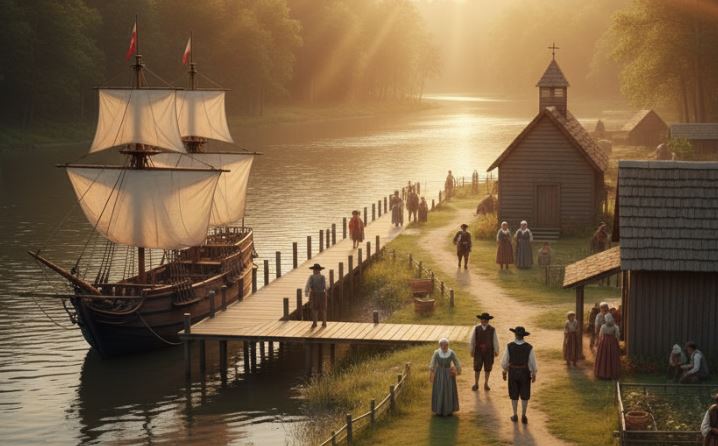
The colonists’ journey culminated in March 1634, when they arrived at a promising location on a tributary they christened St. George’s River (known today as St. Mary’s River). Here, they encountered an abandoned village of the Yaocomico people. Through a peaceful and mutually beneficial exchange, the English acquired the land for tools and goods, establishing their foothold without immediate conflict. This new home was christened St. Mary’s City.
- Established: March 27, 1634
- Crucial Role: St. Mary’s City proudly claims the title of Maryland’s first permanent European settlement. For 61 pivotal years, from its founding in 1634 until 1694, it served as the bustling colonial capital of Maryland.
Pioneering Tolerance and Growth
From its early days, St. Mary’s City quickly became a beacon of Lord Baltimore’s groundbreaking vision for religious freedom. In stark contrast to many other fledgling colonies, Maryland explicitly extended freedom of worship to all Christians. This radical principle was formally enshrined in the landmark Maryland Toleration Act of 1649, positioning St. Mary’s City as a unique sanctuary in a world often fractured by religious strife.
The settlement flourished into a vibrant community, characterized by thriving farms, sturdy homes, and a busy port. Tobacco rapidly became the lifeblood of the economy, fueling the colony’s expansion. Despite navigating challenges such as complex relations with Native American tribes, occasional skirmishes with neighboring Virginia (notably Claiborne’s Rebellion), and internal political tensions, St. Mary’s City persevered and grew.
A Historic Site Preserved
The status of St. Mary’s City as the colonial capital eventually shifted in 1694, when Annapolis was designated the new seat of government. This relocation was prompted by a combination of factors, including the Protestant Revolution in Maryland and a strategic desire for a more centrally located capital. Over time, St. Mary’s City receded from its former prominence, its colonial structures gradually returning to farmland. However, this period of quiet dormancy inadvertently proved to be a blessing, safeguarding much of its invaluable archaeological integrity.
Today, Historic St. Mary’s City stands as a dynamic living history museum and an active archaeological site. Visitors are invited to step back in time, exploring meticulously reconstructed colonial buildings, engaging with knowledgeable historical interpreters, and witnessing ongoing archaeological digs that continually unearth new insights into Maryland’s earliest chapters. It serves as a powerful, tangible link to the bold vision and resilient spirit that forged the fourth English colony in North America.
Conclusion:
So, what’s Maryland’s first permanent settlement? The answer, unequivocally, is St. Mary’s City. This historic site is far more than just a geographical location; it represents the bedrock principles of religious freedom and strategic foresight that profoundly shaped Maryland’s distinct identity and its enduring legacy in American history.
Follow Us!