When tourists come to Philadelphia to find history, they usually line up for Independence Hall or the Liberty Bell. They are looking for the story of 1776.
But if you head south along the Delaware River, past the bustle of Center City, you will find a building that was already an “old” landmark when George Washington was born.
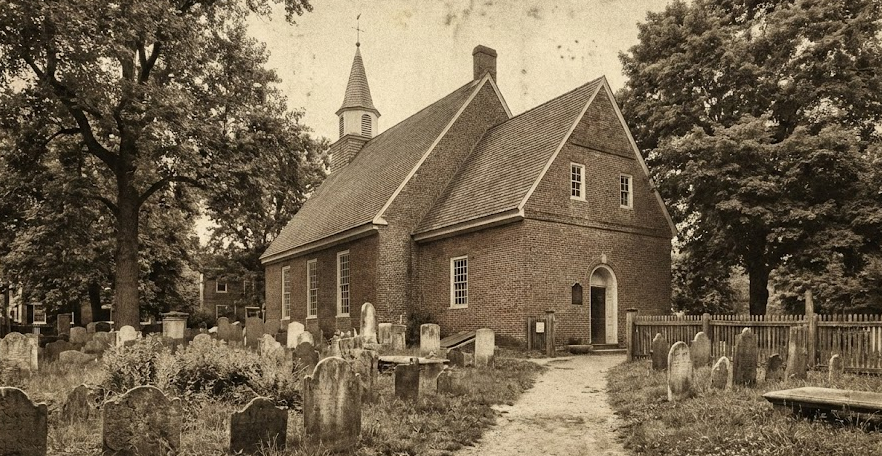
This is Gloria Dei (Old Swedes’) Church. Dedicated in 1700, it is the oldest surviving church building in Pennsylvania. It stands as a lonely, brick testament to a forgotten colony that existed long before William Penn arrived: New Sweden.
The Colony That Time Forgot
To understand Gloria Dei, you have to rewrite your mental timeline. We often think Pennsylvania began with the English Quakers in 1682. But by then, Swedish farmers had been living along the Delaware River for decades.
In 1638, Sweden established the colony of “New Sweden” in parts of modern-day Delaware, New Jersey, and Pennsylvania. Although the Dutch and later the English eventually conquered the territory, the Swedish settlers stayed.
They were allowed to keep their land, their language, and their religion. In the 1690s, realizing their wooden log churches were rotting, the congregation decided to build something permanent.
A Masterpiece of Resilience
Construction on the current building began in 1698 and was dedicated on the first Sunday after Trinity in 1700.
The architecture is a blend of Swedish simplicity and English durability. The builders used Flemish bond brickwork (a pattern of alternating long and short bricks) which creates a distinctive checkerboard look. The walls are notoriously thick, built to withstand harsh winters and, if necessary, hostile attacks.
It was designed to last, and it has. While the city of Philadelphia grew up around it—transforming the area from forests to shipyards to wharves and eventually to the modern neighborhood of Queen Village—the church remained untouched.
The Drift from Swedish to English
For over a century, the services at Gloria Dei were conducted entirely in Swedish. Ministers were sent across the Atlantic from the Church of Sweden to lead the congregation.
However, as the generations passed, the children of the settlers married English neighbors and stopped speaking the mother tongue. The “Swedish mission” officially ended in 1831 when the last Swedish missionary died.
In 1845, the congregation officially joined the Episcopal Church, which is why it remains an active Episcopal parish today.
Secrets of the Sanctuary
If you visit today, there are two details you shouldn’t miss that hint at the church’s unique origins:
1. The Hanging Ships Inside the nave, you will see models of sailing ships hanging from the ceiling. This is a Scandinavian tradition known as a “Votive Ship.” They are gifts given by seamen to thank God for safe passage, or to ask for protection. It is a visual reminder that this was a congregation of river people and sailors.
2. The Ancient Graveyard The churchyard surrounding the building is one of the oldest burial grounds in America. It contains the graves of Revolutionary War captains, Civil War soldiers, and the original Swedish families.
Visiting Today
Gloria Dei is unique because it is both an active congregation and a National Historic Site managed in cooperation with the National Park Service.
- Location: 916 S. Swanson St, Philadelphia, PA (Queen Village neighborhood).
- Admission: Free. You can walk the grounds from dawn to dusk. The interior is often open during the day, but it is best to check their schedule as it is still a working church with weddings and Sunday services.
Follow Us!