
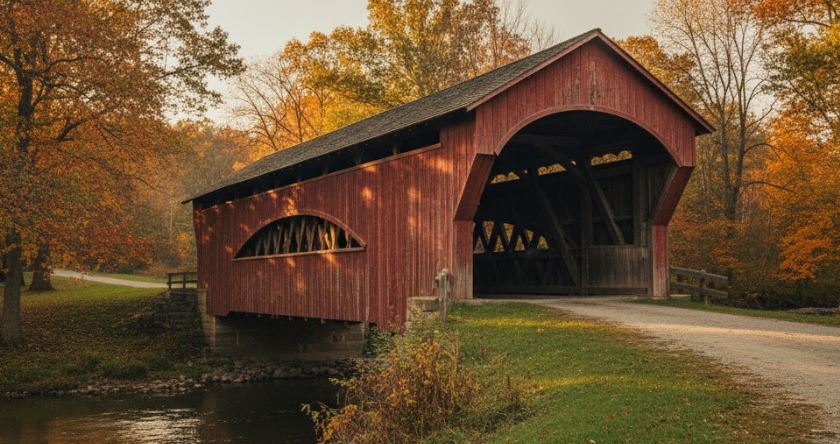
Pennsylvania, often called the “Covered Bridge Capital of the World,” boasts an impressive collection of these charming, historic structures. More than just picturesque relics, covered bridges were vital infrastructure in their day, protecting the wooden timbers from the elements and extending their lifespan. While many shorter examples dot the landscape, some stand out for their impressive length, whispering tales of bygone eras and the ingenuity of early American builders.
While pinpointing the absolute “longest” can be tricky due to historical changes, reconstructions, and varying definitions of “length” (e.g., span vs. total structure), several Pennsylvania covered bridges consistently rank among the longest and most historically significant. Let’s embark on a journey to discover some of these majestic wooden tunnels.
Barrackville Covered Bridge (West Virginia – Pennsylvania Border, Formerly)
Though technically residing mostly in West Virginia, it’s worth mentioning the Barrackville Covered Bridge as it represents a significant historical link. While not entirely within Pennsylvania, its story often intertwines with discussions of the region’s longest bridges. Constructed in 1853, this 145-foot structure is a classic example of the Burr Arch Truss system. While its direct connection to Pennsylvania’s longest internal bridges might be debated, its historical context in the broader mid-Atlantic covered bridge narrative is undeniable.
Bridge Valley Covered Bridge (Bucks County)
Venturing into the heart of Pennsylvania, the Bridge Valley Covered Bridge in Bucks County is a notable contender. Built in 1841, this bridge spans 103 feet across Neshaminy Creek. While not the absolute longest by some metrics, its length combined with its age and the beauty of its surrounding landscape makes it a beloved and well-preserved example of early 19th-century craftsmanship. Its kingpost truss construction is typical of many early Pennsylvania bridges.
Knecht’s Covered Bridge (Bucks County)
Also in Bucks County, Knecht’s Covered Bridge, also known as “Valley Mill Bridge,” is another impressive structure. Built in 1873, it stretches 110 feet over Cooks Creek. This bridge showcases the beauty of the town lattice truss, a popular design known for its strength and relatively simple construction. Its length allows for a wonderfully atmospheric drive or walk through its timbered interior.
Dr. Knisely Covered Bridge (Lancaster County)
Lancaster County is a treasure trove of covered bridges, and the Dr. Knisely Covered Bridge (sometimes referred to as the Knoxly Covered Bridge) is a prime example of a substantial structure. Built in 1877, this 103-foot long bridge crosses the Pequea Creek. It’s a classic example of the double Burr Arch truss, a robust design that allowed for longer spans. Its rural setting adds to its timeless charm.
The Significance of Length
The length of these bridges wasn’t just a matter of aesthetic grandeur; it was a testament to the engineering challenges overcome by their builders. Constructing longer spans required a deep understanding of forces, materials, and truss systems. The Burr Arch Truss, often employed in Pennsylvania’s longer bridges, was particularly effective in distributing weight and allowing for greater lengths than simpler designs.
These long covered bridges served as vital arteries for commerce and travel, connecting communities and facilitating the movement of goods and people across rivers and ravines. They were community landmarks, often becoming central to the identity of the towns they served.
Preserving the Legacy
Today, these longest covered bridges are cherished historical assets. Preservation efforts are ongoing, ensuring that future generations can marvel at their construction and experience a tangible link to Pennsylvania’s past. Driving or walking through one of these elongated wooden tunnels is a unique experience – the soft light, the echoing sounds, and the scent of aged timber transport you back to a simpler time.
Exploring Pennsylvania’s longest covered bridges is more than just a scenic drive; it’s an immersive journey into American history, offering a glimpse into the ingenuity, craftsmanship, and enduring spirit of a bygone era. They stand as silent sentinels, bridging not only rivers but also the centuries.
Follow Us!