
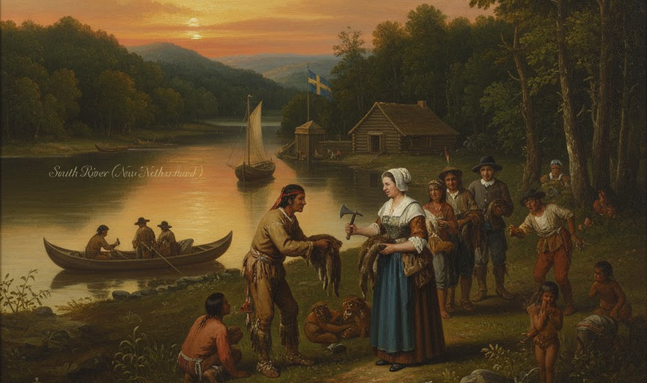
Before officially becoming the “First State” in 1787 by ratifying the U.S. Constitution, the land that would eventually be known as Delaware underwent several name changes and affiliations, reflecting its complex colonial history. It wasn’t always a single, unified entity, and its identity was shaped by the competing interests of various European powers and proprietary governments.
Early Native American Inhabitants and Names
Long before European arrival, the land was inhabited by indigenous peoples, primarily the Lenape (also known as the Delaware Indians), who had their own names for the rivers, lands, and settlements. These names, often descriptive of the natural environment, were the original “names” of the region.
The Arrival of Europeans: New Sweden and New Netherland
The first permanent European settlement in what is now Delaware was established by Sweden in 1638, near present-day Wilmington. They called their colony New Sweden. This period saw the construction of Fort Christina and the establishment of trade relationships with the Lenape. However, Swedish control was relatively short-lived.
In 1655, the Dutch, who had established the colony of New Netherland (centered around present-day New York), conquered New Sweden. For a time, the territory became part of New Netherland, often referred to by the Dutch as the “South River” region, distinguishing it from the “North River” (Hudson River) area.
English Takeover and the “Three Lower Counties”
The English seized New Netherland from the Dutch in 1664, and the land along the Delaware River eventually came under English control. For a significant period, the territory was known as the Three Lower Counties on Delaware. These counties were New Castle, Kent, and Sussex.
These “Lower Counties” were initially part of Pennsylvania, granted to William Penn in 1681 by the Duke of York. Penn’s charter for Pennsylvania actually included this land. However, the residents of the Lower Counties, primarily Dutch, Swedish, and English settlers who had arrived before Penn, had different concerns and interests than those in the rapidly growing Pennsylvania settlements further north. They felt underrepresented in the Pennsylvania Assembly.
Separate Assembly, But Still Tied to Pennsylvania
Because of these differences, Penn granted the Three Lower Counties their own separate legislative assembly in 1704. While they had their own assembly and could make their own laws, they still shared a common governor with Pennsylvania until the American Revolution. Essentially, they were a distinct governmental entity, but not fully independent.
“Delaware State” Emerges
As tensions with Great Britain escalated, the Three Lower Counties declared their independence from both Great Britain and Pennsylvania on June 15, 1776, even before the formal Declaration of Independence by the Continental Congress. They began referring to themselves as the “Delaware State” and adopted their first state constitution in September 1776.
So, while “Delaware” itself is derived from Lord De La Warr, an English colonial governor, the land wasn’t officially “Delaware State” until the eve of the American Revolution. Before that, it was a complex tapestry of “New Sweden,” a part of “New Netherland,” and most enduringly, “the Three Lower Counties on Delaware” within William Penn’s vast colonial holdings. It was this identity as the “Three Lower Counties” that directly preceded its transition into the independent “Delaware State” and its subsequent role as the first to ratify the U.S. Constitution.
Follow Us!