
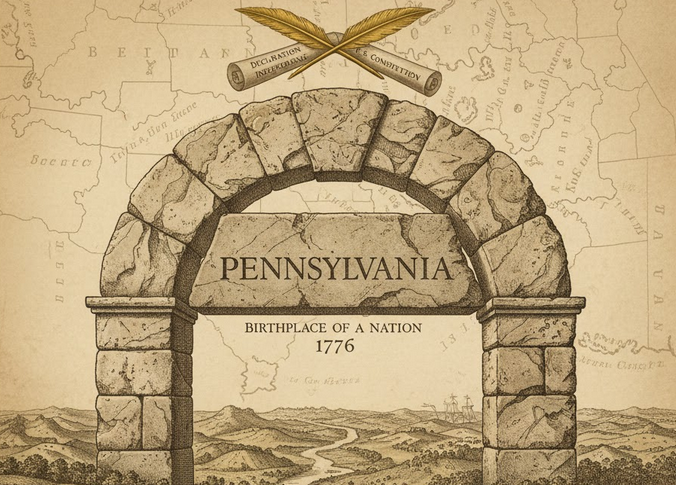
Pennsylvania, a state rich in history and natural beauty, proudly carries the moniker “The Keystone State.” This nickname isn’t just a catchy phrase; it’s a testament to the state’s pivotal role in the formation of the United States and its enduring importance in the nation’s economic and political landscape.
To understand why Pennsylvania earned this distinguished title, we need to delve into its historical significance. The term “keystone” itself refers to the central, wedge-shaped stone at the apex of an arch, which locks all the other stones into place and supports the entire structure. Without the keystone, the arch would collapse. This architectural metaphor perfectly encapsulates Pennsylvania’s position among the original thirteen colonies.
The “Keystone” of the Original Thirteen Colonies
Geographically, Pennsylvania was centrally located among the original thirteen colonies. When looking at a map, it literally sat in the middle, connecting the northern colonies (like New York and New England) with the southern colonies (like Virginia and the Carolinas). This central location made it a crucial crossroads for trade, communication, and movement between the burgeoning settlements.
More significantly, Pennsylvania played a critical role in the political arch of the nascent United States. Philadelphia, its largest city, served as the meeting place for the Continental Congress, where the Declaration of Independence was debated and adopted in 1776. It was also in Philadelphia that the U.S. Constitution was drafted and signed in 1787. These monumental events, which laid the foundation for American democracy, firmly established Pennsylvania as the “keystone” of the new nation. The ideas and compromises forged within its borders were essential for holding the diverse colonies together and forming a unified country.
Economic and Industrial Powerhouse
Beyond its political centrality, Pennsylvania also became an economic keystone. Its fertile lands, abundant natural resources, and access to waterways made it a hub for agriculture, particularly in grain production. By the 19th century, Pennsylvania transformed into an industrial powerhouse, driven by its vast coal reserves and flourishing iron and steel industries. Cities like Pittsburgh became synonymous with American manufacturing and innovation. This industrial might provided the backbone for the nation’s growth and development, further solidifying its “keystone” status in terms of economic contribution.
A Legacy That Endures
Today, the spirit of the “Keystone State” continues. Pennsylvania remains a vital contributor to the nation’s economy, with diverse industries ranging from advanced manufacturing and technology to healthcare and education. Its historical sites draw visitors from around the world, reminding them of the foundational moments that occurred within its borders. The nickname serves as a constant reminder of Pennsylvania’s enduring legacy – a state that was, and continues to be, integral to the strength and stability of the United States.
So, the next time you hear Pennsylvania referred to as “The Keystone State,” remember that it’s more than just a name. It’s a recognition of its historical, geographical, and economic significance – a true keystone in the grand arch of American history.
Follow Us!