
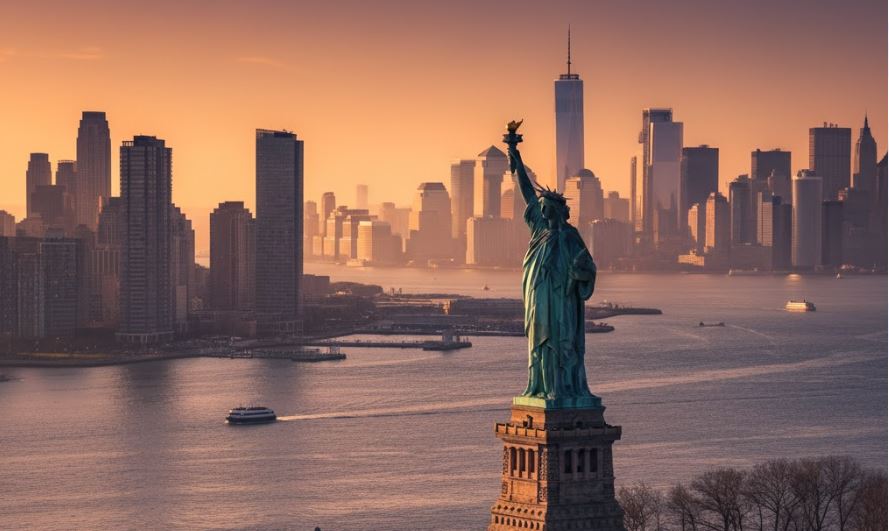
It’s one of America’s most enduring symbols of freedom and democracy, instantly recognizable to millions around the globe. The Statue of Liberty, officially located on Liberty Island, is synonymous with New York City. Yet, anyone gazing at Lady Liberty from the New Jersey waterfront might notice something intriguing: the island appears to be much closer to the shores of the Garden State. So, why isn’t the Statue of Liberty in New Jersey? The answer lies in a fascinating piece of colonial history and a little-known interstate agreement.
The Heart of the Matter: Geography vs. Jurisdiction
Geographically, there’s no denying that Liberty Island is nestled within the waters that would typically fall under New Jersey’s domain, specifically Hudson County. The distance from Jersey City, New Jersey, is significantly shorter than the journey from Manhattan, New York. This proximity often leads to confusion and, occasionally, friendly rivalry between the two states.
However, legal jurisdiction isn’t always dictated by the shortest swim.
The Critical Agreement: The Compact of 1834
The primary reason for Liberty Island’s New York designation dates back to a crucial agreement known as the Compact of 1834. After years of disputes over the shared waters of the Hudson River and New York Harbor, New York and New Jersey reached a landmark accord, mediated by the U.S. Congress.
This compact drew a boundary line down the middle of the Hudson River and New York Harbor. Critically for the Statue of Liberty, it stipulated that New York would retain jurisdiction over all the islands in the harbor, including:
- Ellis Island: The historic immigration gateway.
- Governors Island: A former military base.
- Bedloe’s Island (now Liberty Island): The future home of the Statue of Liberty.
This meant that even if these islands were physically closer to the New Jersey mainland, their legal and administrative control would belong to New York.
Early History: Federal Land and State Cessions
Before the Compact of 1834, the island (then Bedloe’s Island, named after early Dutch settler Isaac Bedloo) had a history as federal land. It served various purposes, including a quarantine station and a military fort (Fort Wood), which formed the pedestal for the Statue of Liberty.
While New Jersey initially had jurisdiction over the submerged lands surrounding the island, the state had previously ceded sovereignty over Bedloe’s Island to the federal government in the late 1700s. This cession was for the purpose of fortifications, establishing it as federal property.
The Final Word: A Supreme Court Decision
Despite the 1834 Compact, debates over the exact boundary and jurisdiction resurfaced occasionally. In the 20th century, particularly concerning Ellis Island (which also straddles the perceived New York-New Jersey border), the U.S. Supreme Court weighed in.
In 1998, a Supreme Court decision reaffirmed the principles of the 1834 Compact, explicitly stating that Liberty Island remains exclusively within the territory of New York. While some of Ellis Island’s landfill additions were later deemed New Jersey territory, the original island and, crucially, Liberty Island itself, remained firmly under New York’s wing.
A New York Icon, Forever
So, while the Statue of Liberty might seem to be waving at New Jersey from a stone’s throw away, its official home is, and always has been, New York. It’s a testament to how historical agreements, rather than simple geography, often define our modern political landscapes.
Follow Us!