
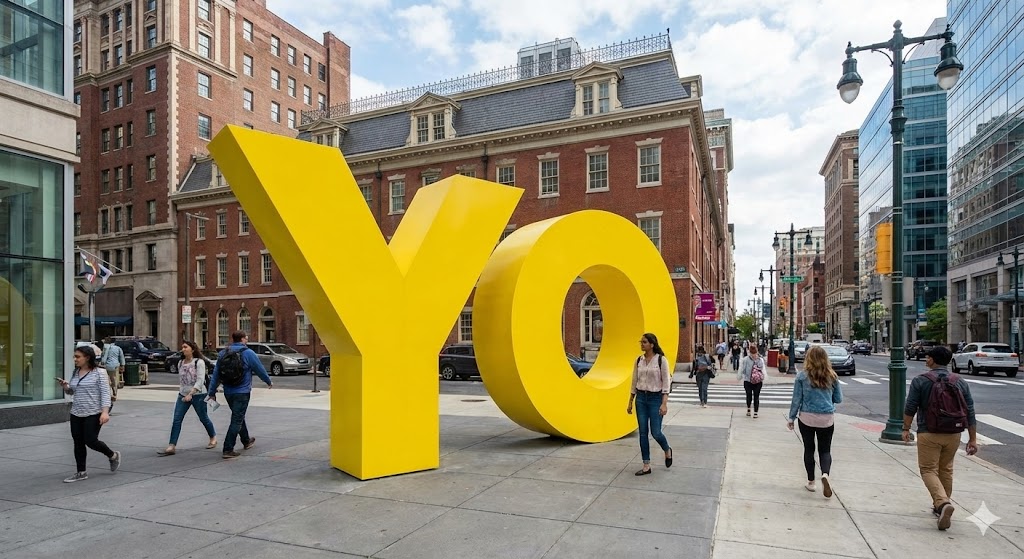
It’s the greeting, the warning, and the exclamation that defines a city. From South Philly stoops to the steps of the Art Museum, we trace the origins of the two letters that speak for millions.
PHILADELPHIA — If you walk down any street in Philadelphia today, you will hear it. It’s shouted from car windows on Broad Street, whispered between friends in Rittenhouse Square, and barked by construction workers in Kensington.
“Yo.”
To an outsider, it might sound like a lack of vocabulary. To a Philadelphian, it is the most versatile tool in the English language. As the city prepares for its 250th birthday and a global spotlight in 2026, the word “Yo” has never been more relevant—or more misunderstood.
The Neapolitan Roots
While “Yo” has been part of Middle English for centuries as a simple exclamation, the Philadelphia version was born in the 1930s and 40s in the Italian-American neighborhoods of South Philly.
Linguists trace the city’s specific “Yo” to the Neapolitan word guaglione (pronounced “gwahl-yo-nay”), meaning “young man” or “boy.” Over decades of neighborhood shorthand, the word was chopped down to wahl-yo, then simply to the sharp, attention-grabbing Yo.
By the time Sylvester Stallone shouted “Yo, Adrian!” in 1976, the word was already the undisputed king of the Philly lexicon. Stallone didn’t invent it; he just gave the rest of the world a chance to hear it.
The “Swiss Army Knife” of Slang
What makes the Philly “Yo” unique isn’t just that we say it—it’s how we use it. Depending on the pitch, length, and volume, “Yo” can mean a dozen different things:
- The Greeting: A quick, upbeat Yo is the standard Philly “Hello.”
- The Warning: A sharp, staccato YO! means you’re about to walk into a pole or someone is about to take your parking spot.
- The Disbelief: A long, descending Yoooooo… is the only appropriate response to a wild story or a shocking Eagles trade.
- The Comma: In many Philly sentences, “Yo” simply acts as a verbal placeholder, keeping the rhythm of the conversation moving.
A Sculpture of Identity
The word’s status as a cultural icon was solidified recently when the “OY/YO” sculpture at 5th and Market Streets was made a permanent fixture outside the Weitzman National Museum of American Jewish History.
The bright yellow, 8-foot-tall letters speak to the city’s dual identity: From one side, it’s the quintessential Philly “Yo”; from the other, it’s the Yiddish “Oy,” representing the diverse, gritty, and soulful mix that makes Philadelphia what it is.
Is “Yo” Being Replaced?
In recent years, the word “jawn” has dominated national headlines as the quintessential Philly slang. But while “jawn” is a noun that can replace any person, place, or thing, it lacks the functional utility of “Yo.”
“People love to talk about ‘jawn’ because it’s a novelty to them,” says local historian Mike Rossi. “But ‘Yo’ is the foundation. You can’t even use a ‘jawn’ correctly without a ‘Yo’ to start the sentence. It’s the heartbeat of how we talk.”
As millions of tourists prepare to descend on the city for the 2026 World Cup and Semiquincentennial, “Yo” will likely be the first thing they hear when they step off the plane—and, if they’re lucky, the first word they learn to use like a local.
How do you use “Yo” in your daily life? Is it a friendly “Hey” or a “Get out of my way”? Let us know your favorite Philly slang in the comments!
Follow Us!